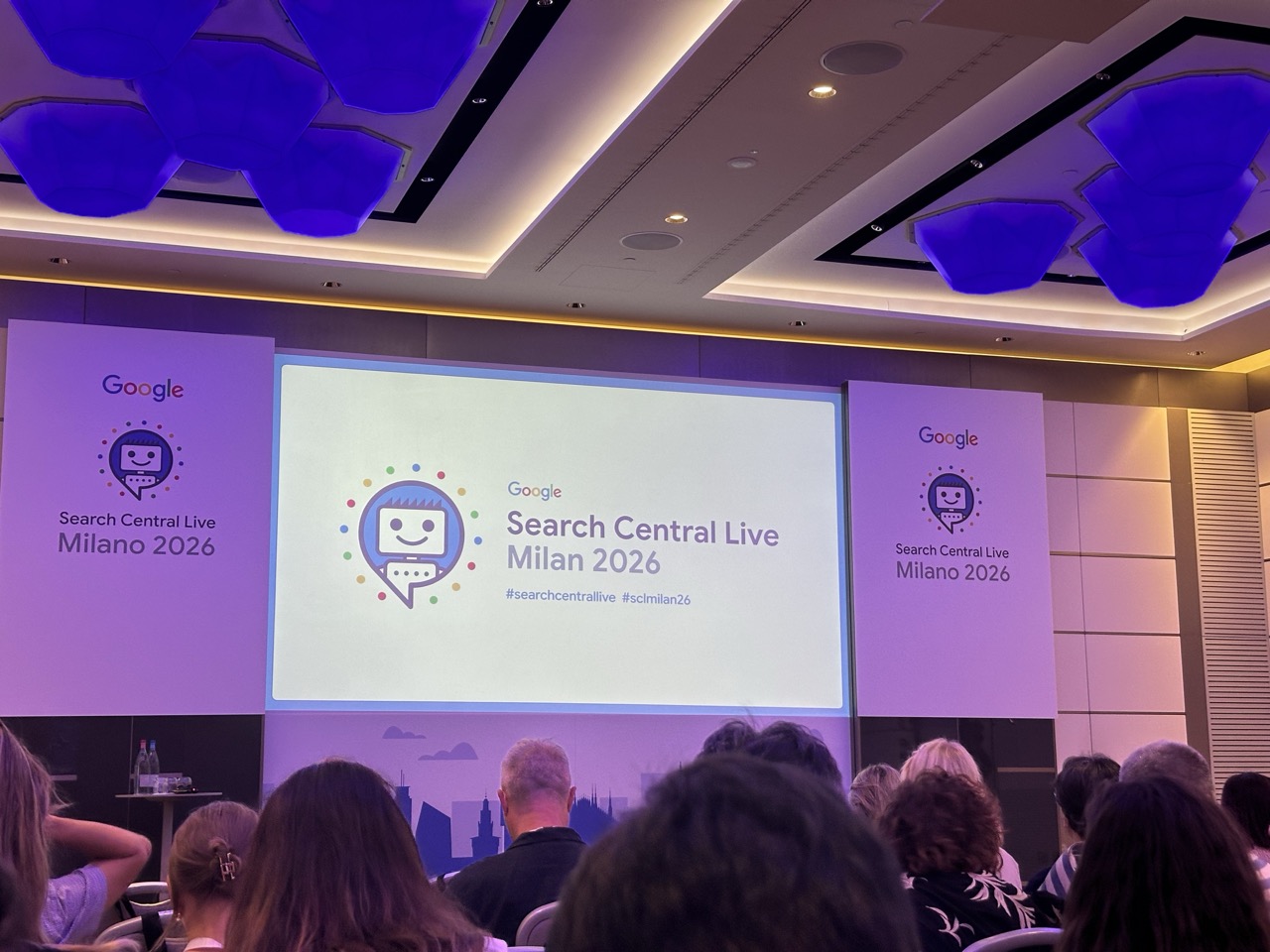
Google held a Search Central Live event in Milan this week and spoke about several topics including chunking, site-wide signals, AI settings in Search Console, commondity versus non-commodity content, paywalled content, subscriptions for news sites, branded vs. non-branded filter in Search Console, what clicks look like from AI Overviews and much more.
It is great to see Google cover so many of these important topics at the Search Central Live events around the world.
I almost always get into trouble quoting presentations from tweets from events I did not attend, so I won't be adding my own commentary but rather share other commentary. So here we go mostly with Stefano's tweets but also commentary and more on those tweets from others:
15% of daily searches processed by Google are completely net-new.
— Stefano (@SearchStefano) June 18, 2026
A URL's lifecycle follows a rigid pipeline.
Crawl inefficiencies almost always stem from a misalignment in these phases, often exacerbated by sharp demand fluctuations or incorrect robots.txt directives. pic.twitter.com/fGIBx55yu9
...Complex queries trigger the "Fan-out" mechanism, expanding them into parallel sub-searches to enrich the returned link graph.
— Stefano (@SearchStefano) June 18, 2026
SERP evolution and new interface labels. To encourage interaction with authoritative profiles and entities, the global Preferred Source feature is introduced in Top Stories and AI responses (Google suggests adding onsite buttons to make it easier for users to subscribe)...
— Stefano (@SearchStefano) June 18, 2026
Google introduced subscription linking with the Reader Revenue Manager. Integrating paywalled structures via this setup significantly improves content discovery for existing subscribers, with internal case studies showing a +34% boost in user engagement. pic.twitter.com/bekxOMLhCN
— Stefano (@SearchStefano) June 18, 2026
Have paywalled content? Make sure your subscribers can find your content in Search easier. See slide below about 'subscription linking' and how they could see "From your subscription" in the SERPs: https://t.co/pVAcMYYxrt
— Glenn Gabe (@glenngabe) June 18, 2026
Rewarded content must be Unique (unreplicable viewpoints), Specific (vertical case study analyses), and Authentic (first-hand field experience). Generic guides based on rewrites or macro-rules are losing relevance. pic.twitter.com/rRI4cr5SH6
— Stefano (@SearchStefano) June 18, 2026
From Stefano's previous slide: "Content quality criteria: Commodity vs. Non-Commodity Content. Google is taking a restrictive approach against synthetic or programmatic texts lacking proprietary data (Scaled Content Abuse)."
— Glenn Gabe (@glenngabe) June 18, 2026
And "first-hand field experience" is important.… https://t.co/LHAPKptjh7
...not fix structural deficits in the domain's intrinsic quality. Diversifying traffic sources is recommended to mitigate algorithmic dependencies. pic.twitter.com/vbGJkE1ayh
— Stefano (@SearchStefano) June 18, 2026
Yep, I have covered Google's site-level quality algorithms for a long time. I have a post dedicated to that topic for those that are new to the concept. It's super important. URLs are not islands, they are part of your overall site. And site-level quality can drag rankings down,… https://t.co/JNRPWgqqEM
— Glenn Gabe (@glenngabe) June 18, 2026
Analytics data indicates that traffic originating from internal links within AIO responses registers a significantly higher dwell time. The user lands on the page with an informational context already pre-conditioned by the AI.
— Stefano (@SearchStefano) June 18, 2026
The official slide stated: 'We've seen when people click from AI Overviews, they're more likely to spend more time on the site.' But it didn't provide any absolute numbers or percentages. :(
— Stefano (@SearchStefano) June 18, 2026
GSC Update 2. The AI Reporting (Beta) section has entered rollout to isolate impression and click metrics related to AI Overviews, AI Mode, and Discover. The AI Settings panel has also been integrated, allowing site administrators to explicitly include or exclude their site. pic.twitter.com/dzZ5pB7JY7
— Stefano (@SearchStefano) June 18, 2026
...Once cleaned, typed data is extracted as a pristine context layer to directly power AIO and A
— Stefano (@SearchStefano) June 18, 2026
...This implementation allows dynamic, personalized member pricing to be surfaced directly in search results and AI responses. pic.twitter.com/kKRl5C73UD
— Stefano (@SearchStefano) June 18, 2026
Google is working on "Cross-page @id linkage" to allow products to reference global organizational policies distributed across different URLs, reducing code redundancy...
— Stefano (@SearchStefano) June 18, 2026
Technical mythbusting and false SEO myths straight from official documentation:
— Stefano (@SearchStefano) June 18, 2026
No algorithmic reward exists for formal HTML validation (Google's parsers bypass specification errors).
Forcing paragraph "chunking" for AI is useless; content organization must follow human...
Regarding chunking -> "Forcing paragraph "chunking" for AI is useless; content organization must follow human readability criteria." https://t.co/qLHPJG4ta4
— Glenn Gabe (@glenngabe) June 18, 2026
On "Vibe Coding" and AI-assisted development: Google addressed the trend directly. While AI can build basic scripts or tools, engineers must critically evaluate the long-term security, maintenance, and architecture costs recommending official endpoints like the GSC API instead...
— Stefano (@SearchStefano) June 18, 2026
This is what I was able to take away from this great event! I hope to see you all again next year. pic.twitter.com/pQpGSNreuY
— Stefano (@SearchStefano) June 18, 2026
Forum discussion at posts above...