Since Google added AI Overviews to Google Search, many of us have been experiencing what some call the crocodile effect, also known as the great decoupling. But according to new data, the opposite may be happening with Google Shopping Ads.
Mike Ryan from Smarter Ecommerce posted new data that shows how Shopping Ads seem to be getting fewer impressions and more clicks, as a click-through rate percentage. He wrote on LinkedIn saying, "Here's an odd one. Ever since AIOs launched, publishers have been gaining impressions and losing clicks: the dreaded SEO "crocodile effect." For Shopping ads, it's the opposite. But why?"
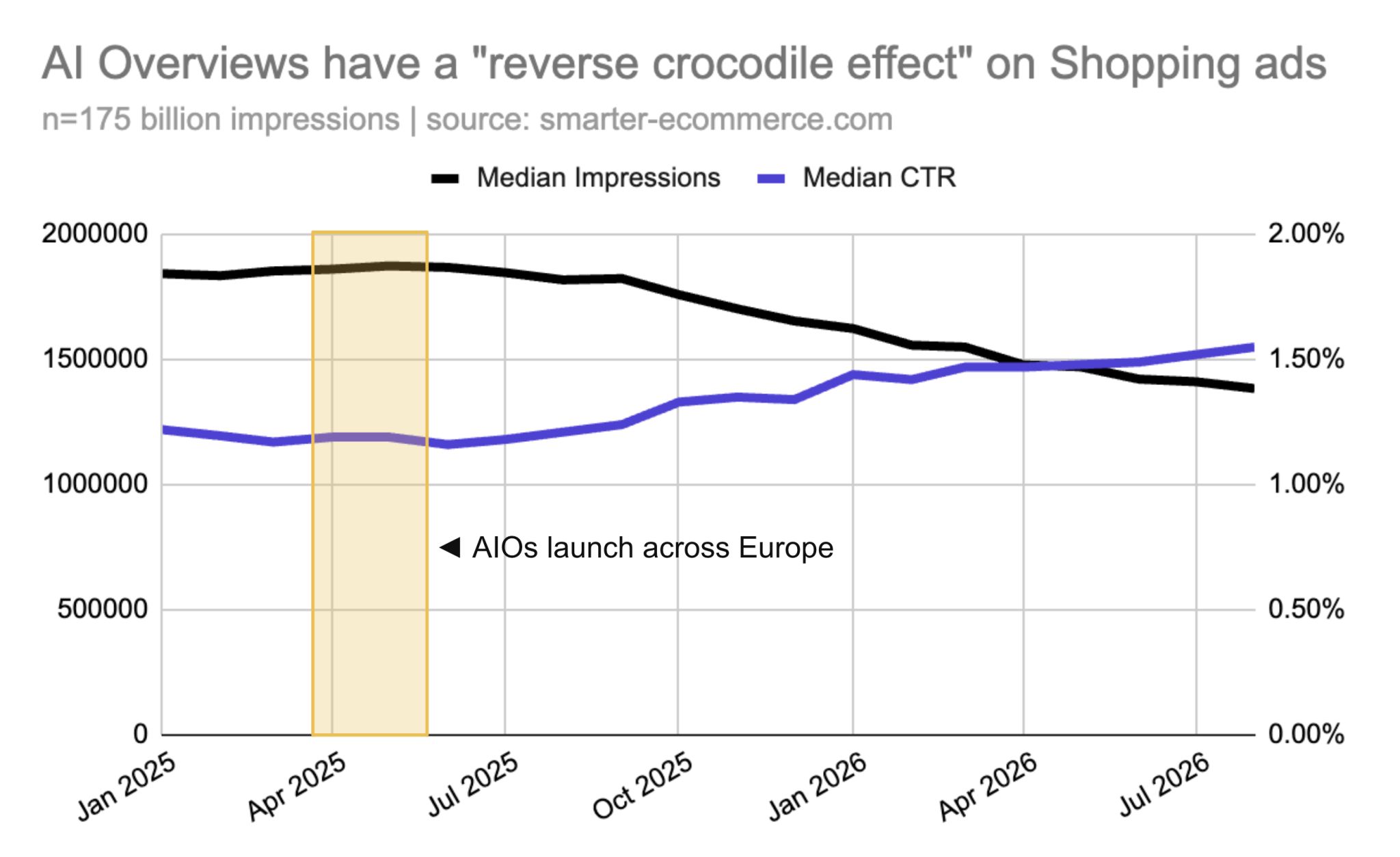
You can call this the "reverse crocodile effect" in Google Shopping ads, where median ad impressions steadily decline while median click-through rate (CTR) steadily increases following the expansion of AI Overviews (AIOs).
This includes 175 billion impressions, so it is a lot of data. And it shows that between mid-2025 and mid-2026, median Shopping ad impressions fell from roughly 1.85 million to 1.4 million, while median click through rate climbed from 1.20% to nearly 1.55%.
Here is that chart:
Why is this happening? Mike posted his theory, he wrote:
Google checks the predicted CTR of a given query and serves AIOs preferentially for lower-probability queries in order to preserve revenue. Thus CTR climbs partly due to a shrinking denominator (fewer impressions) and partly due to selection/pruning (higher click propensity).If true, I'd view this as a bridging strategy. They'll shift the balance from more "either/or" experiences toward more "both/and" experiences. This will particularly as Google launches AI-native formats with higher predicted CTR, and scales the presence of Shopping ads *in* AIOs.
What do you think?
Forum discussion at LinkedIn.