

Google Ads has posted a new help document about the data strength uplift metric. This comes a month after Google posted another help document on Data Strength Best Practices. "The data strength uplift metric gives you a clearer picture of the value your first-party data setup delivers in Google Ads," Google wrote.
The data strength uplift metric estimates the percentage of additional conversions reported over the past 14 days attributed to your adoption of durable measurement features, such as enhanced conversions, Google Tag Gateway, and Data Manager connections.
You can find this metric:
- In Summary within the Goals menu.
- +X% additional conversions reported within the past 14 days: Shows the estimated percentage of additional conversions (both observed and modeled) captured through your first-party data features compared to a standard baseline setup (displayed from +1% up to >50%, refreshed daily).
- Active status hover card details: Hovering over the Active conversion tracking status displays a summary of how your measurement accuracy is improved when you leverage first-party data features such as enhanced conversions, Google tag gateway, and Data Manager connections, along with a direct link to Data Strength best practices.
Here is how it works. Modern privacy changes and signal loss can create gaps in traditional conversion measurement. When you adopt first-party data solutions in Google Ads, Google can recover and accurately attribute conversions that standard tagging alone might miss.
- Holistic 14-day rolling view (refreshed daily): The data strength uplift metric refreshes daily using a rolling 14-day lookback window across eligible online (website) and offline conversion actions. It compares your current setup (including observed and modeled conversions from enhanced conversions for leads, Google tag gateway, and multi-source Data Manager connections) against a baseline setup (a standard website tag for online conversions or GCLID-only imports for offline conversions). If you use multiple first-party data features simultaneously, the metric deduplicates overlap across those features to provide a single combined uplift percentage.
- Works alongside your existing reporting: The uplift metric is a directional percentage increase over your baseline conversions and replaces legacy single-feature impact cards. It complements your standard Conversions and All conv. reporting columns and does not change how your conversions are billed or optimized in Smart Bidding.
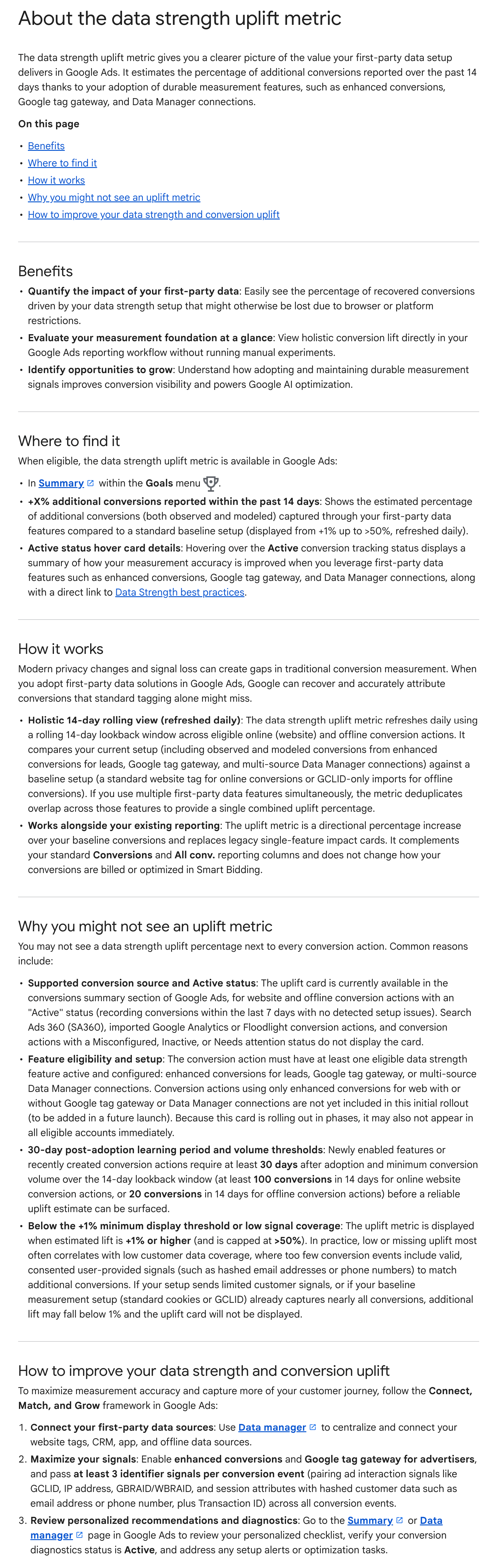
Here is a screenshot of this document:
Forum discussion at X.