

Google will update how it handles multi-channel products, products sold both online and locally in the store, to help with managing inventory. Google emailed merchants that this applies to and the changes go into effect this March.
You can use multi-channel products to manage your inventory for both online and in-store sales within a single, unified product listing. Google explained that "this approach simplifies how you manage your products and helps you reach more customers." With multi-channel products, you can oversee your online and in-store inventory together. Previously, you might have maintained separate listings for the same product if you sold it both online and in physical stores.
Previously, when you submitted product information for both online and physical store sales using certain methods, the system might have created 2 separate internal records for that product. These records could sometimes be modified independently, potentially leading to different information for your online and in-store versions of the same product. With the updated multi-channel product system, we are moving towards a more consistent approach. Product information for both online and in-store availability will be managed in a more unified way, reducing the chances of attribute differences between the online and in-store versions of your product.
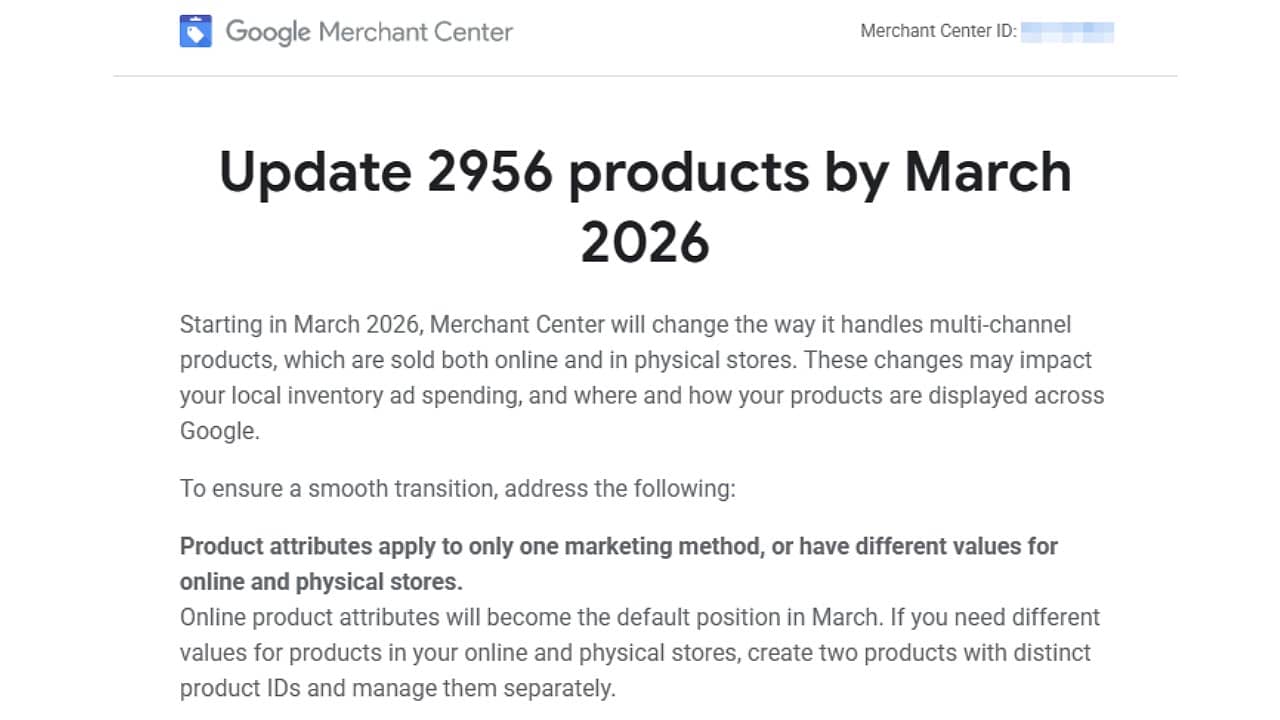
The email, which was posted by Hana Kobzová on PPC News Feed reads:
Starting in March 2026, Merchant Center will change the way it handles multi-channel products, which are sold both online and in physical stores. These changes may impact your local inventory ad spending, and where and how your products are displayed across Google.To ensure a smooth transition, address the following:
Product attributes apply to only one marketing method, or have different values for online and physical stores.Online product attributes will become the default position in March. If you need different values for products in your online and physical stores, create two products with distinct product IDs and manage them separately.
Here is a screenshot of that email:
Here are the "key changes" Google posted:
- Unified product representation: Your products, intended for both online and in-store sales will be managed as a single multi-channel product.
- Consistent product data: The system will work to ensure that core product attributes (like title, description, etc.) remain consistent for a product, whether it's shown for online or in-store purchase.
- API users: For products managed as multi-channel, you will interact with a single product representation. The channel field within the ProductStatusDestinationStatus object in the Content API can help distinguish how a product is performing across different programs like Shopping ads or local inventory ads.
Note: The channel field is a part of
ProductStatusDestinationStatusobject of the Content API. Although the "channel" fields in the new systems like Merchant API may be supported as legacy features, it's important to scope the new field "channel"' to the soon-to-be-deprecated Content API. - Potential conflicts: If you submit a product intended for multi-channel sales (online and local) and a separate local-only product using the same product ID, content language, and feed label, this may result in processing issues or errors.
Note: If a multi-channel product is set up for your physical stores and has local inventory, ensure it doesn't use the same product ID, content language, and feed label as an existing product submitted only for local inventory ads. Using the same information for both can cause conflicts.
- Consistent Attributes: With multi-channel products, the aim is to have consistent core attribute values for a product across both online and in-store displays. If you need to maintain different attributes for ad targeting (like custom label
[custom_label]) for the online versus the in-store version of a product, we recommend using 2 distinct products with unique product IDs. - Supplemental Data Sources: If you use supplemental data sources to provide additional product information, ensure they are kept up-to-date. Outdated information in supplemental data sources can lead to inaccuracies in your product listings.
- Unique Product Submissions: Submitting the same product (identified by its ID, content language, and feed label) through multiple primary data sources can lead to processing errors. We recommend ensuring each unique product is submitted using a single, authoritative primary data source to maintain data accuracy and clarity.
Note: Previously, uploading products with the same ID, content language, and feed label through multiple data sources could lead to unexpected behavior, along with an “ item uploaded through multiple feeds” error. With multi-channel products, these instances now result in errors to ensure data accuracy and clarity.
Forum discussion at X.