
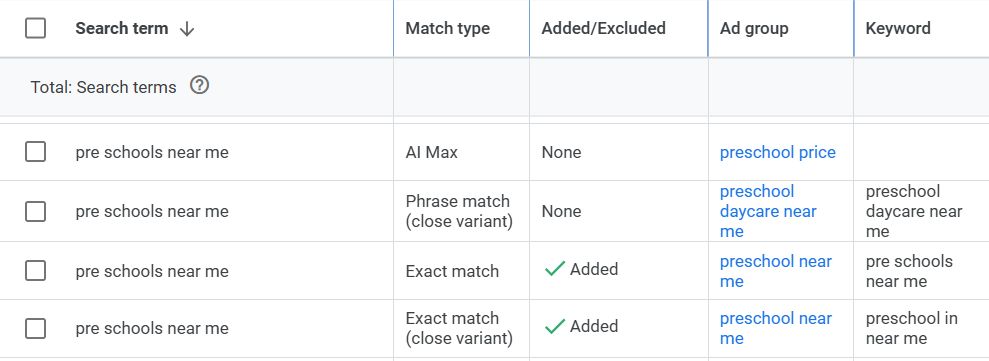
Brad Geddes dug into how he felt "AI Max can trump your existing exact and phrase match keywords and then claim credit for the conversions and revenue." And then Google's Ad Liaison, Ginny Marvin responded to those specific examples on why this happened and what Google is changing in the future with Google Ads AI Max.
It might be easier to first read Brad's blog post named The hidden challenges of AI Max search term reporting. Brad summed it up on LinkedIn as saying:
Many conversions from AI Max are not actually incremental. AI Max can trump your existing exact and phrase match keywords and then claim credit for the conversions and revenue.In our latest column, we go through the challenges and logic of working with AI Max search terms.
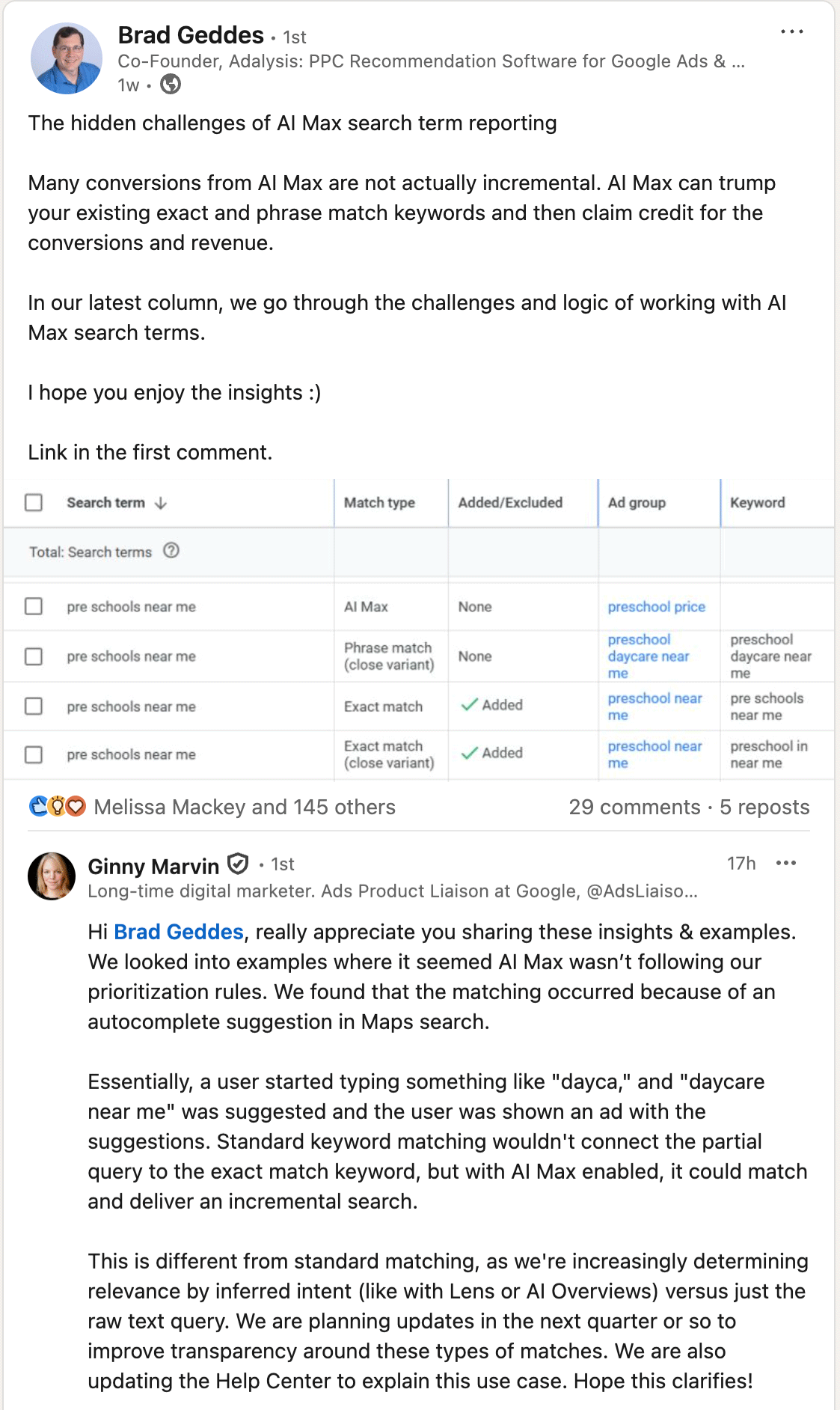
Ginny Marvin from Google responded on LinkedIn to explain where this exactly came from, which is super transparent and makes AI Max easier to understand. Here is what she wrote:
Hi Brad Geddes, really appreciate you sharing these insights & examples. We looked into examples where it seemed AI Max wasn’t following our prioritization rules. We found that the matching occurred because of an autocomplete suggestion in Maps search.Essentially, a user started typing something like "dayca," and "daycare near me" was suggested and the user was shown an ad with the suggestions. Standard keyword matching wouldn't connect the partial query to the exact match keyword, but with AI Max enabled, it could match and deliver an incremental search.
This is different from standard matching, as we're increasingly determining relevance by inferred intent (like with Lens or AI Overviews) versus just the raw text query. We are planning updates in the next quarter or so to improve transparency around these types of matches. We are also updating the Help Center to explain this use case. Hope this clarifies!
So it was following the rules and it was just hard to understand? She said, "We found that the matching occurred because of an autocomplete suggestion in Maps search." "This is different from standard matching, as we're increasingly determining relevance by inferred intent (like with Lens or AI Overviews) versus just the raw text query," Ginny Marvin added.
But this will lead to better reporting, transparency, and help documentation. She wrote, "We are planning updates in the next quarter or so to improve transparency around these types of matches. We are also updating the Help Center to explain this use case."
Pretty cool!
Forum discussion at LinkedIn.