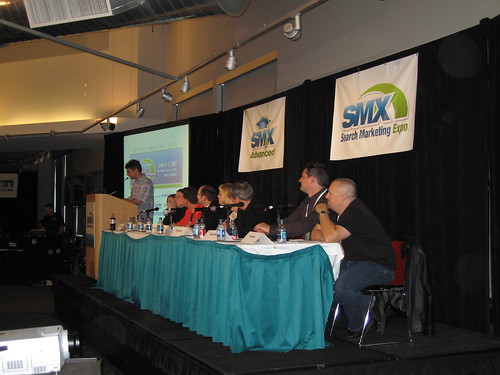
Search Marketing Expo 2007 Seattle Archives

Video: Matt Cutts Warns Against Link Buying

When I covered the You&A With Matt Cutts at SMX Seattle, I was only liveblogging - there was no video. But now, here's a video that confirms that Matt Cutts has said about link buying:

As you can tell, Matt confirms that link buying is not in the best interest of the user, and DigitalPoint Forums members have taken note. Interestingly, Google made a clarification yesterday that Google frowns upon excessive link exchanges because they want high quality results and not any that seem to be manipulated.

Still, forum members doubt that Google can determine if links are bought, but some people won't take the risk. They know what's at stake:

It is your site and you are free to do what you want with it. It is their search engine and they are free to include whatever sites they wish.

Forum discussion at DigitalPoint Forums.

posted Tamar Weinberg in Google Optimization at August 16, 2007 9:39 AM Comments (5)

Give It Up at Search Marketing Expo (June 5th, 2007)

As Barry said, we had an embargo on posting this for one month. It was composed on June 5th at 3:30PST (6:30EST) but publication was delayed (until July 5th at midnight GMT) due to the announcement by Danny that he'd kill us if we publish this beforehand. He gave us a real hard time about it and I'm afraid for my head so I have thus complied. Sorry for causing the wait, but I hope that it's an exciting read.

Moderator:
Danny Sullivan, Editor-in-Chief, Search Engine Land

Speakers:
Greg Boser, Search Engine Marketing Consultant, WebGuerrilla
Bruce Clay, President, Bruce Clay, Inc.
Todd Friesen, Director of Search Engine Optimization, Range Online
Mike Grehan of Bruce Clay
Jennifer Slegg, Owner, JenSense.com
Stephan Spencer, President, Netconcepts, LLC
Mikkel deMib Svendsen, Creative Director, deMib.com
Shari Thurow, Webmaster & Marketing Dir., Grantastic Designs
Jill Whalen, CEO and Founder, High Rankings

Give It Up! at Search Marketing Expo

Danny Sullivan: This was going to be called a "Do Evil" session but we decided that it wasn't an appropriate name. We're going to discuss some of the best secrets in SEO.

Matt Cutts of Google shares his story by talking about his favorite spammer of 2006. He opens with: How would you like to get 7,000 domains for free and get PageRank from eTrade?

He talks about DNS. When you buy a domain, you own it for a year, but you also have hosting. Some people don't park a domain when they buy a domain. A lot of times, the domain server is set to lamedelegation.org. Millions of domains have been marked as such. Not at all of those were set that way, however. Some were set to lame-delegation.org, which does exist. A very smart Bulgarian spammer ended up registering lame-delegation.org and now had these domains that he didn't even pay for it. (In Google, we check for this. I don't know about the other search engines.)

Stephan Spencer has 7 tips in 7 minutes:
Secret #1 - Grouped results: Google groups results from the same site together. To find the true position of an indented (grouped) result, you can add a &num=9 to the domain search to see if indented listing drops off.
Secret #2 - view potentially cloaked page when "cached" link is not available. Use Google Translate and Translate it from English to English. http://translate.google.com/translate?hl=en&sl=en&u=URLGOESHERE
Secret #3 - Change Google preferences to English only. Google number of results is widely underestimated. The results will then decrease by 2/3rds.
Secret #4 - Free Analyst reports - search Google for "forrester research grapevine endnotes filetype:pdf"
Secret #5 - Build a link building spider - look for sites one-click away from Google; look for sites with a high PR; and with preference for sites that already give link love to patron/sponsor. If you're 2 or 3 clicks away from a Google property, it's good. e.g. look what's linked to code.google.com - python.org is a PR8 linked there. Buy a link on there! Find sites like this and help them out.
Secret #6 - Cloak your home page. You can eliminate superfluous characters.
Secret #7 - Link build your existing links. Mine your backlinks for opportunities to revise your acnhor texts. Pull some favors with friends. Use the We Build Pages Neat-o Tool for this.

Shari Thurow is up next.
My SEO technique is always about usability. What made me a better SEO? I took a class. The description of the class was "The organization of information / information organization and access." This is a library science class. If you have the time and budget, take the class. Everybody gives fabulous tips. You have to get out of that tip mentality and evolve and think out of the box.
The other thing is that I read some articles.
MJ Bates (Oct 1989) - "The design of browsing and berrypicking techniques for the online search interface"
Michael Buckland (Sept 1997) - "What is a document?"
I learned that search is not a linear process. People don't go to Google, search, and then make million of dollars. Search encompasses more than querying. You should focus on refining, browsing/surfing, scanning, reading, expanding, foraging, pogosticking, and reading.
What did this teach me?
- When you hear the word "document," you think it's text-based. Metadata is a text-based document surrogate.
When you optimize a document, compensate for all these search behaviors. Think of an interface and CMS that addresses both of them.
Gather as many tips as you like. Measure and test them, but move beyond cat-and-mouse mentality. All of us should evolve. If you have time, take classes. Implement the knowledge into the optimization process.

Mikkel deMib Svendsen discusses his tips next. He doesn't want to give out his secrets because Matt is in the room. However, he discusses the possibility of revealing other tips:
- What should people read?
- How can you scrape Google without penalties?
- How can you do fun stuff with cross side scripting?
- How can you do computer based writing?
- What's Matt's phone number?
Content creation is what he ends up settling on.
One of the big challenges is finding that quality content: Computer generated writing. Watch the movie Epic 2014. http://epic.makingithappen.co.uk.
Computer generated writing is here to stay. It is going to improve and get better.
What are the kinds of computer generated writing? Randomizing words and phrases and word replacements.
Semi-advanced systems: Markov Chains
Very advanced systems: original content-writing

What about quality of content creation?
I am pretty sure we will get there.
What we have now is not much worse than the average writing on the web.

What are examples?
Cloaking sites - great keyword rich unique filter texts which scales well.
Spam blogs - splogs - they can be used for a lot. It won't look much sillier than the average blog out there.
Data feeds/affiliates - advanced rewriting of standard product descriptions from merchants.
Foreign language sites - take the keywords from a foreign language system and you can then rewrite it without even knowing the language!

Markov Chains: a sequence of random values whose probabilities at a time interval depends upon the value of the number at the previous time.
eblong.com/zarf/markov

There are 2 pieces - the Markov builder and Markov generator
The builder is based on source text; a frequency table is built for every word pair.

Add additional processing of output - retrigger it, make keyword density adjustments, blend with other methods (works great with other "automated content types"), and create keyword based cross-linking (great for freshness)

What can you do?
Make your own tools.
Get good sample texts. Search for a keyword and scrape 10-30 pages that rank. Wikipedia is a nice page to go to.
Experiment: set up your tools where you can adjust variables.
Generate as much text as you want.

Bruce Clay is up next.

The first thing he discusses is siloing.
- Traffic increases 30% or more
- Aligh by query, not random groupings
- Landing pages receive internal links (and popularity voting) across themes
- Anchor text management is critical
http://www.bruceclay.com/newsletter/volume29/themepartone.html

The second thing is training.
- Arguing about every action slows the project.
- Training pulls the team together.
- Failure to speak the same language results in missed expectation and "blaming"
- The SEO is always to blame.
- Project success more than doubles if the team all understands what is happening.
- Training is critical. Customer satisfaction has more than doubled with training.

The third thing is universal search - what's next?
- Futures research
- Embrace change
- Understand that participation in the Internet is critical to Brand Protection. Social media has eroded the brand - social media determines whether a brand exists or not.
- Do it all: blog, video, podcasts, RSS, social - make it a religion or be gone in 5 years.
- Think inter-galactic.

The last thing is to increase traffic.
- Add a metatag to bruceclay.com. (Obviously, he's totally kidding*.)
- Your mileage may vary.
- His point is that we need to understand that there is no magic meta tag.
*In fact, he adds a footnote on his slides that says: "Note: If you do this, you need more training."

Mike Grehan of Bruce Clay (recent acquisition) goes up next.

Mike says that he cloaked a website because he was working with a TV company that had a popular TV program in the UK and their website was totally animated. But now he thinks that the rules are changing because now there are animations showing up in results (videos, etc.)

Rolling out Universal Search is the scariest thing - you need to think differently about the way you optimize. Do a search for "shakira" and notice that the first result is under an image and is thus below the fold. People are going to click on the picture instead of any other SERP.

Now do a search for "American Airlines" - the site links are pushing other results below the fold. If you then click on the stock quote plus-sign, things go even further below the fold.

There's more than just writing copy now. People searching have broadband. Think different.

Link building is important but it is not the most important thing. The quality of the link is the most important thing. He talks about how he had to rank #1 for "restaurants in london." It's very competitive so he ended up going offline to the top 3 critics in the UK and forced them to eat there so that he'd still get the link.

Jill Whalen says that she doesn't have many secrets but shares the following:
* Alt attribute of a logo
- alt attribute text = anchor text.
- Linked from every other page
- Big money (competitive) phrase or word - make sure it describes your site completely

* Dynamic titles and descriptions
- For titles - use the last 3 phrases from breadcrumbs, in reverse order, plus company name.

* Dynamic descriptions
- Generic description at each category and page level
- Substitute the keyword phrase appropriately

* If all else fails
- Use the trapezoidal linking multiflux!

Jennifer Slegg speaks next about link love.

Internal link love -
- As you add new content, link from homepage
- Each content page should link to 2-3 related articles
- Don't bury pages on the site - 2 to 3 clicks maximum

Anchor text -
- Keywords that surround your anchor text can influence
- Avoid Google Bombing by ensuring that the keyword is on the page.

Buying links -
- Vary keyword phrases when buying links (10-20 variations; distribute links unevenly)
- Check backlinks on the link page
- Avoid common placements (footer, sidebar). Do it in the text of an article instead.
- Avoid commonly known link networks.

External Link Love
- Link to authority pages in your niche
- Use nofollow on links where you don't want to give authority to.
- Use target=_blank for external links.

Link Baiting
- Carefully crafted linkbait can get you a lot of links very quickly: top X ways to..., tools/giveaways, quizzes/contests/awards, breaking news/huge exposes/exploits/scoops, rants/controversies
- Caution: all linkbait can backfire badly. People might criticize you on the stance. If you think your target is weak but they can be best friends with people who can hurt you. You may need reputation management at that point.

Todd Friesen will talk next.

He says that if you want information, you should buy him a drink.

He says that they focus on multivariate testing. SEO is moving beyond traffic; it's now about conversions. You should use multivariate on landing pages for natural search, not only PPC. Offermatica is a great multivariate testing company.

Bread crumbs and title tags - you should consider where you put your brand but it depends on your brand strength. If you are not a known brand name, you should put it at the end.

Buying links should be thought of as media placement. linkexperts.com is a great link network. When you work with them, they view it as a media buy - great targeting. Buy links on a topical site, not on unrelated sites or thousands of blogs.

bazaarvoice.com is a company that provides customer reviews for products. They are unique to every site and are moving beyond product reviews to places like education, finance, and law. It plugs really well into your site.

For people with large sites, you should put 3 or 4 of the top level categories into the footer across the whole site and within days you will see a boost in traffic. Footers are largely underused. Nobody cares much about your privacy policy. Add navigation, if nothing else, to those categories.

What if you move from one URL structure to another? If you don't do it right, you might lose your rankings. I came up with a short process that helps with that - you build out your sitemap (XML) for the old site. Get your new site ready to go, build out the XML sitemap for that site. Focus on the domain architecture. Then map out 301 redirects for all old pages to new pages. Then, go ahead and launch the new site. Submit your old sitemap to Webmaster Central and SiteExplorer. Ideally, if your 301 is set up, the engines will do the redirection. Once your changes propagate over, upload the new sitemap. It worked very effectively for us.

Greg Boser is up last.

He talks about 301 redirects and getting creative with redirection. You can do good things or bad things with it. 301 redirects do not get utilized as much as they should. They can be like robots.txt files on steroids. We can use robots.txt to exclude links, but you can 301 one copy of a page to another copy. Then, the juice of 2 pages can be consolidated to one focal point. Google credits links very quickly but those backlinks may not show up immediately. If you want to get clever, you can mask where your juice is coming from.

If you own small sites that are not popular, buy some links from crappy directories to these sites and test redirection to another popular site. You can always turn it off (or deflect it at the competitor). Don't be afraid to toy with it or to be bot-specific.

Todd added about moving from sitemaps from one structure to another - he says he wrote an article for MediaPost.com.

Danny says:
- If you ever want to read an NY Times article and it asks you about membership, just get the original URL from the link generator at nytimes.blogspace.com.
- On the Google blog, if they do permalink, you can click on "Create a link" and get nice traffic. But you either want to be the first person to link or the last person (after 30 days). Google blog search takes what's in the actual feed. Make sure it's in the first sentence of your blog post.

posted Tamar Weinberg in Search Marketing Expo 2007 Seattle at July 4, 2007 7:00 PM Comments (6)

Why The SMX Muffler

While SMX appears to have to impressed most attendees and been a success for Danny and Chris as they re-invent the conference wheel, the impressions from the outside world are starting to filter in.

Two threads from Cre8asiteforums illustrate the curiosity from the SEO industry.

Why Were They Forbidden to Blog? (Registered Members only) asks about the one month embargo put on writing about one particular session. With no reasons to point to that were made public, some people are wondering why.

[Added by Barry]: Danny said the reason is because he didn't want any blogging on this at all. But he finally agreed to a one month embargo. It gives the attendees something a bit extra for coming to the conference, I guess. Danny actually wrote before the conference started that no blogging would be allowed at this session (I just can't find where he wrote that now).

What It Means to be a Conference Speaker hopes to explore the speaker world. With more conferences available, where to do you draw the line? Whom do you pitch to? Who wants you? Is anyone paid to speak?

posted cre8pc in Search Marketing Expo 2007 Seattle at June 6, 2007 8:27 AM Comments (2)

Give It Up! at Search Marketing Expo

After a long, heated and (probably) annoying fight, Danny would not allow coverage of the Give It Up! session at the Search Marketing Expo conference.

Give It Up! at Search Marketing Expo

So this is me blogging that you are not allowed to blog the Give It Up session.

But don't worry, we were given permission to post our notes from this session one month later. So I have asked Tamar to schedule the post to go live in one month from now. Maybe we will even clean it up for you.

I will say that Danny allowed Matt Cutts of Google to sit in only if he gave up a secret no one knew. Matt agreed and he gave up something, but I can't say what it was.

Now the remaining speakers are up now and giving up some of their secrets.

Greg Boser, Search Engine Marketing Consultant, WebGuerrilla
Bruce Clay, President, Bruce Clay, Inc.
Todd Friesen, Director of Search Engine Optimization, Range Online
Mike Grehan, Founder and CEO, Searchvisible Ltd.
Jennifer Slegg, Owner, JenSense.com
Stephan Spencer, President, Netconcepts, LLC
Mikkel deMib Svendsen, Creative Director, deMib.com
Shari Thurow, Webmaster & Marketing Dir., Grantastic Designs
Jill Whalen, CEO and Founder, High Rankings

We will be posting this coverage in one month from now, unless someone else breaks the embargo.

posted rustybrick in Search Marketing Expo 2007 Seattle at June 5, 2007 6:54 PM Comments (3)

Giant Focus Group

Moderator: Jeffrey K. Rohrs, VP Agency & Search Marketing, ExactTarget

Panelists:
John C. Kim, Senior Director, Advertiser Product Marketing, Yahoo! Search Marketing
James Colburn, Product Manager, Search Strategy & adCenter Go To Market, Microsoft
Tom Leung, Product Manager, Google, Inc.
Paul Vallez, Director of Product Management, Ask.com

John Kim, Yahoo:
I want you to start thinking about different ideas that Yahoo is interesting in hearing about from you. Some of the things we’d like to give you to think about are:

Trends/Key Hypotheses
• More Search Tools Developing To Improve User Experience
• Search Formats and Types are Changing
• Best of Breed is Still King
• Off-Browser Search Could Explode
• Ranking and Matching Based on Personalization and Community Factors

Implications
• Need More Data – SKU level information, meta data
• Needs Ads in Multi-Media Formats
• More Vertical Fragmentation
• More Experimental Models to Emerge
• Less Transparent

More Trends
• 360 Audience or Action Based Buying
• Organizational Silos Becoming the Norm
• Increased Bifurcation of Advertisers Into Sophisticated and Unsophisticated Advertisers
• No More Time for Experimentation and New Tools
• More Fragmentations and Customized Needs
• More Focus on Interaction Effects and Advanced Analytics


1. How do you think these trends will impact you and what do you need?
2. How do we keep it simple for the advertiser?
3. What ideas do you hope emerge from the commercial API program?


James Colburn, MicroSoft:
Really when usually get the opportunity to speak, but this time we are here to listen. There are two focus areas I would really like to focus on: AdCenter and AdCenter Labs.

AdCenter has been in the market for about 13 months now. In this area, I’d like to know your thoughts on what can we improve… editorials, tools, UI, etc.

AdCenter Labs, which is almost exactly a year old, is really being focused on. How many ppl are familiar with the AdCenter Labs? (few hands) How many people would like a quick refresher? (few hands).

Help us shape how we work with you, where we go in the future, etc. (Provides various ways to contact the AdCenter team on the screen).

What I’d like to talk about out front is making sure you’re aware that we have a very strong commitment to increase query share. Our Sr. VP talked about it extensively during the keynote, and I wanted to reiterate here.

Tom Leung, Google
We’d like some “meat and potatoes” feedback, things about the existing tools and features. We’d also like to feedback about new things that we’re trying, and then also we’d like to hear sort of your fantasy wish list for things you’d really like to see. We appreciate everyone coming out. Please don’t be bashful and if you don’t get all your questions answered, please come down to the booth and talk to us personally.

Paul Vallez, Ask.com
Just wanted to take a few minutes to talk about the things we’re working on right now.
Our focus is primarily to ensure that you have the right tools to work with our system in the most efficient way possible. We’re trying to make your advertising campaigns transparent across all ad platforms. One of the things we’re trying to do is show the difference between Search Advertising and Display Advertising…we’re trying out some new types of ads… hybrids, almost, between search and display.

URL Stuffing… we’re working on the ability to include various elements into the tracking URL.

Publisher Controls... Relevancy Thresholds: Work with publishers to define vertical relevancy thresholds; Meet strict relevancy vs. Coverage needs

Ad Performance Thresholds… CPC/CTR Thresholds.

Open Client Questions:
1. How often do publishers want to make changes?
2. Is Vertical Granularity too much?
3. What’s the right interface? API vs. UI (both?)

Open Questions/Feedback

Q: There seems to be an uneven enforcement in policies when it comes to trademark violations in paid search. Do you have any plans to offer new tools to help advertisers see people using their trademarks in campaigns?

(silence)

Paul: That’s a hard one to solve. We tend to approach that manually. On the SE side, I imagine it’s very difficult to keep track of which terms are okay to use and which aren’t.

John Kim: I just read a media post about how Saatchi and Saatchi got fired for using the image of Kurt Cobain w/o permission. That was an asset management issue rather than a trademark issue, but they’re similar issues for the SEs.

James Colburn: How many ppl would like a clarification on how the trademark violation policy works at Microsoft? (third of the room raises hands)

Tom Leung: If you own a TM and you’re very concerned about other ppl using your terms in ads, there’s already a place in AdWords where you can indicate you’d like to prevent other ppl from using your terms in their campaigns.


Q: Why can’t you go through the USPTO’s db of trademarks and cull out all the trademarks and *know* who is authorized to use them and who isn’t?


Q: I would like to see Google have an alt-text feature or some way that we can specify parameters like misspelled keywords, etc.

JC: How many people find parameters confusing or annoying? (a few hands)

Q: On the AdWords editor… it crashes ALL THE TIME. We have a campaign with a million keywords. We’ve escalated it through our contacts, and if we move our account to a new one, we’ll lose all the history. For Yahoo, I don’t seem to have the support level that I’d like… do you see that changing anytime soon?

John Kim: We’ll have Stew Easterby chat with you after the session.

Feedback: The way my management system works, impression share is important to me. Ask gives it to me once a week, but the others don’t really at all and I’d love to get that from them. Also, exclusion keywords are my best friends… they improve my CTR and they’re good for you because they help you make the most of your inventory… I think there should be more keyword exclusions. Also, I’d like to be able to switch geography to see what the SERPs will look like in each of the geographical locations I’m targeting.

Question: Has anyone found the UI on AdCenter is confusing? How many people get lost in the UI? (a smattering of hands)

Feedback: I’d like to see something so if you have an acronym… like DVD or CD that it actually LETS you have all caps instead of Cd or Dvd since it makes us look stupid.

JC: Just so I can do a little nyah-nyah we already have that. We already have that in AdCenter.

Feedback: We’d like to see more explanation regarding why we’re getting discounted clicks (as a result of detected or suspected click fraud) because my executives are wanting to know what exactly was happening to cause you to give us a discount or a refund without us asking for it.

TL: We definitely understand your need for transparency, but at the same time, we have to not be completely transparent because by providing too much detail, we’ll be exposing the system to additional exploitation. So we really have to walk a fine line, but I’ll definitely be bringing your concerns up with our team because I understand where your team is coming from and why they want that information.

Matt Van Wagner (in audience): I have a question about the letter S and plurals. Why don’t you open up the ability to differentiate between plural and singular forms? I think that’s something people are interested in, am I right? (Chorus of YES!) Is that something you can do? Please, please please?

Also, are you other guys considering putting in any historical data like Google is currently offering?

Paul Vallez: What level of granularity are you looking for?

Matt Van Wagner: Not very much… just like major changes… doesn’t have to be really really granular.

(Various heads nodding that it’s something they (the other SEs) either are working on or will work on).

posted cshel in Search Marketing Expo 2007 Seattle at June 5, 2007 6:14 PM Comments (0)

Penalty Box Summit

Moderator: Danny Sullivan, Editor-in-Chief, Search Engine Land

Matt Cutts, Software Engineer, Google, Inc.
Peter Linsley, Senior Product Manager for Search, Ask.com
Tim Mayer, VP of Product Management, Yahoo
Aaswath Raman, Program Manager, Live Search, Microsoft

Penalty Box Summit at Search Marketing Expo

Q: What are you doing to eliminate the .edus ranking for Viagra, etc? Are you banning people based on their WHOIS registration?

MC: Registrars do not automatically get WHOIS info, so I can dispel that misconception right there. Additionally, Google is a very algorhythmically centric engine, so we try first and foremost to “fix” things via the algorithm first and use human intervention and manual fixes as a last resort.

TM: From a Yahoo perspective, the automated approach is much more scalable. So across the whole index, it’s much more feasible to use an automated approach because really, how many pages can real humans touch?

PL: You can employ 2000 people to work everyday for the next 2 years and they still couldn’t clean up all of the stuff that would need to be manually touched.

Danny: The whole Jason Calacanis "we’re going to have Mahalo", etc. It’s that whole idea that we’ll manually build all the search results out and eliminate the spam.

Danny: A suggestion was made that the SEs post some sort of “Johns” list for sites that have been penalized. “Let the rest of their industry know they did something wrong; make examples of people”.

Danny: Is there any frustration that sometimes it’s more about the exact technique, rather than the “intent”.

Question: Life after banishment… cleaned up site, submitted reinclusion request, 6 days, site was back in the index… except there’s no backlinks credited, no PR, nothing. WTF? Are we on parole?

MC: Look at your traffic. Backlinks and PR get pushed every 3 months. You might have caught it in a weird part of that cycle.

Same Questioner: So even though it’s showing 0 for everything, it’s not really gone-gone?

MC: Right. If you continue to have any questions you can contact us and ask someone to take a look at it. It’s also a good time to do an audit… you know when you get a flat, it’s a good time to make sure the rest of the car is in good working order.

Jonah: Why can’t we report spam right out of the SERP? Why do we have to go fill out the form?

AR: Because it can be gamed by your competitors.

Danny: How many of you would like to be able to throw a switch in your WMC console and turn on the Spam Report buttons on the SERPs? (Hands go up)

PL: I would imagine most people prefer a consolidated location where you can report spam.

MC: They do a thing in Germany where they compile a master list of things people don’t like and we (the SEs) can go get that and look at it.

TM: We would want trusted people to go out an report spam. If you make it easier to report spam, the quality of the spam reports will go down.

Question: I really try to get in contact with you guys, and I never hear from anyone. I don’t know if it’s because I’m Canadian or what?

TM: In terms of Yahoo, if you don’t hear back, like sometimes if you’re breaking a ton of rules, you’ll get a very terse “Please review the guidelines”. But if you’re a small mom & pop and just need a few tweaks, you’ll probably get a lot more feedback.

Question: What about if we had some type of wiki where we could agree on coding standards so that they aren’t mistaken as spam?

Lightning Round!

Danny: Shout out a solution in 5 words or less…

-- List of actual penalties
-- Full list of penalties
-- Get more input from webmaster about their own site.
-- Trusted webmasters… give an exam (lots of applause)
-- Give us a "clean" report
-- Trusted API through webmaster tools
-- Maximum number of keywords per tag
-- Better training for advertising reps
-- Ban Viagra
-- Give Viagra away so there’s no profit in selling it
-- Details in the penalty (when, where, when does it end?)
-- Negative Rank on the Toolbar
-- Bad Neighborhood API

Last Word:

AR: (couldn't really hear what he said... he's softspoken and I'm a little deaf)

TM: We have an interface that’s dig like in that you can give feedback. It’s fairly cool. WE’ve been integrated this stuff into site explorer.

MC: We love you infinity times infinity. Seriously, we take spam very seriously. We’re going to keep going forward with our webmaster console.

PL: It’s all about getting the feedback from you guys. We can’t do it without you.

posted cshel in Search Marketing Expo 2007 Seattle at June 5, 2007 6:03 PM Comments (0)

Better Ways

Better Ways

Moderator:
Danny Sullivan, Editor-in-Chief, Search Engine Land

Speaker:
Alex Bennert, Director of Client Services, Beyond Ink
Greg Boser, Search Engine Marketing Consultant, WebGuerrilla
Jim Boykin, CEO, We Build Pages
Christine Churchill, President, Key Relevance
Todd Friesen, Director of Search Engine Optimization, Range Online
Cameron Olthuis, Director of Marketing and Design, ACS
Aaron Wall, Author, SEO Book

Better Ways at Search Marketing Expo

Danny introduces the session and says that it's really called "Better Ways to to Boring Stuff." You can think of this session as an SEO technique clinic.

This is a question-and-answer session instead of a presentation session.

Q: We've seen great results with social media for small clients, but our bigger clients are hesitant to get into that space. They are having difficulty launching their first blog - it took six months to show them that there's value in that. Do you have recommendations on how to ease them into it?
Cameron: We run into the same thing. A lot of education is involved. Reinforce the idea that you'll be doing a lot of reputation management and watching that closely. You can watch the fire and catch it before it goes out.
Aaron: You can reach out to brand evangelists if they don't want to do it on their own site.
Greg: The corporate web world is so slow. Even if you get approval, it takes 6 months and 400 meetings and meetings about the meetings.
Alex: We have a client of a large corporation. They wanted to start a blog. However, it couldn't get through legal. The blog ended up being generously being sponsored through an affiliated company. There is a good halo effect without having to worry about legal stuff because technically it's not their blog; they're just sponsoring it.

Q: I have an open-ended question: how would you scale getting linkbait? What would the tricks or tactics actually do to get a lot of backlinks without having to do much?
Aaron: You can find the key ideas for your topic. When you search for your topics on Google, search for things that are non-commercial that people are interested in. Then write about it. Get really good content for it -- spend a few grand -- and run an ad campaign for keyword permutations that would match that.
Christine: If you happen to be an authority in a certain area, you can give out awards. An example is web2.0 awards of SEOmoz. These have longevity and can continue to build links. Try to look for something that has continuous link-building ability.
Todd: We take a different approach. We have a lot of interns who do directory submissions and we also do link buying. We feel it is media placement and relevant. We also have done widget building. When that HTML is generated, we embed a keyword link with one of the phrases we're trying to target.
Jim: Our approach is "no pain, no gain." We send it via email and do it by hand. You need to write something where you'll expect a response. The days of pressing buttons is over.
Alex: We also try to build it into another part of the business. We have a matching service and offer incentives (referral fees) for links.
Cameron: Use brand evangelists - give them the content and let them do the linkbait or viral stuff for you.

Q: Has anybody got a tool or a way of logging into social networks very quickly?
Cameron: I think anything worth doing is worth putting a little time into it. Pay your dues. (Hurray!)
Danny: How long does it take to log in to them?!
Todd: Use Roboform which logs you in.
Christine: There are scripts that you can add to the toolbar that keep you logged in.

Q: How about developing an accurate keyword research tool? All the ones there suck.
Todd: Have you seen Microsoft's keyword tool? It's a fantastic tool. They have a lot of data including demographic data. They launched it a few weeks ago and they now have an API.
Greg: Why do you think they suck?
Christine: Most of the keyword tools pull information from ISPs so you can get some skewing. Others like Wordtracker pull data from metasearch engines and then have a filtering system which throws out aberrations in the search trends. That’s why the search queries in WordTracker are lower than some of the comparable tools. Keyword Discovery recently made a change in the way they present their data – the default data used to be from ISP data, but just recently they changed the default data to be user toolbar data, so its resonably accurate. They still have the ISP database, they just made the toolbar data be the default. A good thing to do is to use a couple of keyword tools and compare the order of the phrase – and ignore the actual search number. If I see the same phrase above another one above 3 different keyword tools, I can assume that it's a more popular keyword than another one.
Alex: You gauge the relative disparity across different tools. e.g. children's furniture vs. kid's furniture.
Greg: The relationships of the words do pan out very accurately, even if the numbers are different.
Alex: The most accurate source for keyword data is your referral data.
Followup: Our referral data shows different results from those keyword tools.
Christine: Use a PPC campaign. There are a lot of differnet ways to determine this.

Danny gets a poll of which keyword tools are being used. Christine says that Overture is still good for brainstorming even though there isn't a large show of hands.

Q: I have a question about linkbait. Some pages have a lot of icons that add clutter to the page to submit to Digg, Delicious, Reddit, etc. Has anyone done any research on "how much is too much?"
Cameron: I prefer not to include those at all. Generally, what happens is that a lot of stories get submitted to Digg and provide more value to the Digg community, but if the Diggers see that your site is being continually submitted to Digg, they would equate your site with spam. You should add the ones that are most relevant to your userbase.

Q: In a corporate culture, how do you explain to corporate clients that you will be getting links from unrelated sites, unrelated topics, etc. to people who don't get it?
Cameron: I think that the links are pretty relevant. The blogs that link are generally on topic to what you've written about it. There will be a few irrelevant links, but it's not like it's going to hurt you.
Aaron: A lot of links can be polluted anyway across the web.
Todd: It will spread through your group of interest. That's how it spreads. The vast majority of your links will be on target.
Christine: You should have a balance in your links. When you do link-building, you don't want Digg links only, or blog links only. You need to do links over a variety of sources.
Greg: We don't have control over anchor text and what people link to you. However, it helps develop trust to your site to rank better. You should still look for focus, targeted links.
Cameron: You can't control that anchor text but you can influence it by having an applicable title, description, etc.

Q: How many targeted links would you go after a month without penalty?
Aaron: It's all relative to what others are doing and the field you're playing in. Some people go for thousands, and others go for fewer.
Followup: Let's say it's under control and it's not viral.
Greg: The rate that we add links really depends on the space and where your site is in the level of trust. What's good for one might not be good for another. Older sites can get crappy links and it will help you. Newer sites have problems with that.
Jim: I think a lot of sites are concerned about the number of backlinks. It also depends on the quality of the link as well. If a subpage has a thousand links that go to it and you get a link from that page, it's worth a lot more.
Todd: In regards to Greg's comment about fitting into your space, I once got 65,000 links overnight by pressing a button. The top competitor had 3,000 links. Eventually they found me out.

Q: Regarding getting large companies to make the shift, I run into challenges with editorial writing (locked into an old style of writing) that isn't SEO friendly. Also, there are graphic designers who want to build Flash sites that aren't discovered by spiders. Have you had any success stories on getting them to change their minds?
Todd: We have a lot of clients like that. It's a long process of education. Search engines need to understand what the page is about. If you show someone a description of a product without the actual image of the product, people don't necessarily know what the product is that you're describing. You need to make sure it's understandable. Add one word to the writing and make it as simple as possible. That's going to get their attention. A lot of corporate clients are thinking about this as a resource issue of how to get it done.
Greg: If they give you grief, I'll just fire them. It's like pulling teeth. Lawyers ruin everything. Everything hits legal and goes to a grounding halt. I don't work at that level anymore simply because I can't work with clients unless they prove to me that they'll follow through. I like to win.
Alex: In terms of designers, Danny wrote an article that clicks for some of them. Make sure that any designer has a design that is cross-browser compatible. If you think of the bot as a browser, that's how you can help them see how to work on the content.
Christine: Some clients will launch that Flash page regardless of what you tell them. They will learn by being burned. A lot of times, you can then convince them.
Todd: We have clients that have a lot of Flash pages. There's absolutely no way in the world that they will change it. We built out an HTML version of the site and sent a User-Agent delivery to the bots. Call it cloaking as you like, but it's the same page for the search engines.
Greg: We used to use cloaking to prove our case for some of these clients. I would build a bot version of that model and cloak that. All of the sudden, they would believe it.
Danny: You can have a great headline that is keyword rich. Newspapers are struggling behind content behind paid walls. 25% of visitors to newspapers come from search engines. I think that's because they are learning that they need to change the way they write. At Search Engine Land, I talk about that "third browser" - everybody uses a search engine. Designers have to design for IE, Firefox, Safari, etc. But search engines are more popular than all those browsers combined. That idea should resonate with the developers.
Followup: I wanted to followup with that question. I trained journalists to write for search. You shouldn't mention SEO at all. You should emphasize that you're writing for users who use search engines.

Q: I was wondering how relevant page freshness is to ranking. Do we need to reoptimize pages every few months? Sometimes we see pages that rank higher which are crap but are fresher.
Danny: You've never seen this page before and it comes up?
Aaron: You probably see that these newer pages are featured more prominently on their page structure. You need to make sure that your older pages continue to have that prominence. You need to make sure your internal link weight focuses on these types of pages. You should assume that since Google News is now integrated into search, Google is also focusing on newer content.
Jim: Google would try to feed in a fresh page that may or may not last through time. I think there are a lot of people who say that content needs to constantly change and be fresh. Search engines look at this. If you wrote a great page in 1996 and many people linked to it and suddenly you decided to change that content, I believe the search engines see those older links as not having as much value. Newer links, however, would have more value.
Todd: I know a site that has 500,000 links to it and Google says it has 8. You need to use other tools like Yahoo. It might be a freshness issue - it might be something entirely different. Google is constantly tweaking the algorithm. Today, something might have changed. Always make minor adjustments to maintain your position.
Greg: Check your header messages - Google supports the Last Modified date.
Christine: I have pages that I optimized 8 years ago and still rank, so it might not be a freshness issue at all.
Danny shows a Google Blogoscoped blog post that mentions that Google has a QDF value - "query deserves freshness"

Q: Do you have tips that a retailer can optimize in Google Base to go above organic results?
Nobody uses it on the panel.
Someone in the audience says that it doesn't do much for him.
Danny: I'm not actively using base but they are taking more and more database data. They are doing outreach to real estate agencies. Base doesn't yet have that momentum and still needs to be experimented with. They may downplay it but it is going to be Google Real Estate or Google Classified down the line.

Q: Regarding Google Base, we have a real estate company that updates the feed for Google Base. We see that people are scraping the MLS off the feed.
Greg: The playing field is never even. Google gets a lot of duplication in the MLS. Individual agents send their own stuff and then brokers send their own stuff, so I think they're taking only from brokerages and that will hopefully address the spam issue. You always want to hope that the guidelines are evenly enforced/policed. The guidelines say don't do it but Google doesn't allocate the manpower to hit the people who are cheating. Those that understand that push the envelope. So now you have to face your own solution - do I wait for Google or do I compete?
Todd: About a year ago at another conference, Tim Meyer of Yahoo was looking at spam (pills, mortgage, etc), and we concluded that you can't take a sword to a gunfight. Otherwise, you'll miss the opportunity entirely.

Comment from someone in the audience: Eight months ago, I added a Google Base application and we saw some of the results going into a OneBox.

Danny then reviews the Google Universal search and shows how Google OneBox is more prevalent: news results, maps, pictures, and Google Video have gone to replace traditional organic results.

Q: I wanted to know if you have a favorite tool that you use on a regular basis for anything.
Greg: All our stuff is internal that we built ourselves.
Todd: We use a lot of internal tools, but my favorite Firefox tool is SearchStatus. The Web Developer toolbar is also brilliant.
Cameron: We have developed a tool inhouse called Serph, which is a reputation management tool that checks many social media sites.
Jim: We have a We Build Pages Top 10 Analysis tool.
Todd: I also used Aaron's SEO for Firefox extension. We also use Xenu Link Sleuth which will come back with a list of URLs on your site, etc. (He adds: It has a multi-threaded crawl. You can do that to your competitors.)
Alex: Xenu is great and lets you export the entire crawl to a file.

posted Tamar Weinberg in Search Marketing Expo 2007 Seattle at June 5, 2007 6:01 PM Comments (1)

Beyond the Majors

Moderator: Jeffrey K. Rohrs, VP, Agency & Search Marketing, ExactTarget

Panelists:
Anton E, Konikoff, Founder and CEO, Acronym Media
Matt Greitzer, Director of Search Marketing, Avenue A|Razorfish
Scott Greenberg, SVP, Advertising Services, Marchex
T. J. Kelley, VP, Marketing, LookSmart
Tom Paraboschi, Director of Advertising Sales and Agency Relations, MIVA


Anton E. Konikoff

How cool is this to be the final session of the show? So, my name is indeed Anton Konikoff. I run Acronym Media in NYC in the Empire State Bldg (55th floor). What we specialize in is keyword driven marketing. What that is it takes the things we’ve all excelled in as far as marketing and keywords, etc. and applies linguistics and sociology.

We all know who the Oligarchs of Paid Search are… being Russian, I know all about Oligarchs. They tend to be rich, good looking (kinda) and content in exile. The big three (Google, Microsoft and Yahoo) are the oligarchs of Search. You’ll note I didn’t include Ask.com… how many of you consider Ask to be part of the majors? (few hands). Well, I do, but we can argue about that later. So can you imagine the world without those three (plus Ask)? There wouldn’t be much left.

So today, we’re declaring June 5 International Second Tier Search Appreciation Day!

In addition to the general second tier engines (miva, kanoodle, mamma, etc), there are also vertical engines like business.com, kayak, superpages, etc. Plus there are the foreign engines like Baidu.

So when should we consider using second tier engines?
• Large budgets and not enough inventories on GYMa
• Opportunity to lower blended cost/conversion
• Brand defense imperatives
• Client/boss insists on diversification
• Really good looking search engine reps.

So why do I like 2nd tier engines?
• Lower CPC than majors (1 cent)
• Better and unique positioning
• Fewer bidders -> more winners
• Different footprint
• Tap into niche audience segments
• High-touch customer support

Share of paid search budgets
• 1% of search market share == $100 million in revenue, $1 billion in market cap – Don Dodge, Microsoft
• at Acronym, we spend 15% (incl International)

Important Considerations
• Secondary engines do not typically offer conversion tracking
• Lack of APIs and integration with big management tools  manual reporting and optimization is often necessary
• Typically results are not real time – could be up to 48 hours delay
• Do not always report on same metrics

More aspects to consider
• Features: some do not offer geo-targeting, budget options by campaign, landing page testing and multiple ad copy
• Distribution is not always top-notch
• Click fraud potential is thought to be higher
• Not always clear editorial guidelines

Cost-Benefit Analysis
• Spend could be too low to justify effort and time for optimizations
• Evaluate based on campaign needs and imperatives
• Look for an create profitable niches

Optimization Techniques
• Searcher behavior and benchmarks likely to be different from Tier 1
• Launch with volume words that convert well in GYMa
• Test broader keywords that are too expensive in GYMa
• Ad copy MUST be very targeted to pre-qualify visitors (tight ad roups)
• Test, test, test
• Monitor query-driven v. contextual
• Negatives for Sites/Keywords
• Dedicated landing pages?
• Share conversion data, ask vendors for help w/ optimization

Summarize
• Treat Tier 2 as a serious channel, not just a supplement
• Make very few assumptions
• Test, the invest
• Run cost/benefit analysis
• Engage users


Matt Greitzer

I’m going to go through pretty quickly 5 or 10 things and a few of the things Anton talked about.

2nd Tier Spending
• We spent last year (06) $151,000,000
o Of that, considerably less than 1% went to 2nd Tier engines

2nd Tier Challenges
• Operation Barriers – bid management tools and other software aren’t always compatible with the second tier engines.
• Quality Issues, Quality Perceptions – We see very good quality off of 2nd tier engines, but there’s a perception out there that the 2nd tiers are lesser quality and less desirable.
• Low volume – Do your c/b analysis. Is the amount of benefit you’re going to get from working w/ a second tier engine going to be worth the extra 2-4 hours a week you’ll be spending on it?

Success Stories – Travel Client
• Used 2nd Tier engines in the past w/o success
• Re-launched in Q1 07 on Miva and Enhance
• Driving to a targeted landing page
• Benefiting from CPCs 50% lower than other engines
• Drive more volume than MSN, and a more efficient cost per lead.

Success Stories from Vertical Search
• B2B
o Business.com (tech, travel)
o Industry Brains (Financial Services)
• Travel – Trip Advisor
• Retail – Shopzilla, Pricegrabber, NexTag, Shopping.com
o 10%-20% incremental volume
o Feed management


Scott Greenberg

So with a raise of hands, how many people in here are working with second tier engines? (half dozen hands) Are you experiencing success?

Quick Overview of Marchex Search Marketing

1. Pay Per Click Network
2. Contextual Network
3. Search Marketing Services

Marchex PPC Differentiators
1. Focus on traffic quality
a. Our won websites plus top distribution partners
b. Unbilled clicks at 10%-12%
i. (Industry standard: Google 5-10%, Yahoo 10-15%)

(Spends a lot of time explaning the history of Marchex, how they got to where they are today, and what they’re rolling out at the end of the month.)


T. J. Kelley

The LookSmart PPC Network consists of ISPs, Niche Publishers, Mainstream Publishers, Niche Search Sites, LookSmart Consumer Sites, Web Portals, Toolbars, and Meta Search Sites.

So I’d like to focus on these three: Niche Publishers, Mainstream Publishers and Niche Search Sites to show you how we’re going about growing our traffic and increasing exposure for our advertisers.

(Shows a graph of LookSmart Search Queries for One Day)

On our Technology and Services… our platform is scalable and handles millions of queries a day, and we combine that with our customer support, SEM services, campaign tracking, etc.

Tom Paraboschi

I’m going to go over a little about what we’re seeing in the industry.

PPC beyond the majors – why do it?
• Reach people where they spend the majority of their time online
• Increase branding potential
• Extend online reach
• Circumnavigate inventory issues
• Low cost of entry

Quality not quantity focus
• Drive for vertical specific traffic
PPC beyond pure acquisition
• SEM used to support PR
• ATL integration
Many advertisers priced out of search network

… and yet reservations still remain….

Vertical transition through the Precision Network
• Vertically focused PPC
• Spans 18 specific business categories
• Lower volume, higher value leads
• Developed in response to advertiser demand
• ROI
• Focused
• Now out of beta

Case Studies: True.com
Objectives
Increase membership for leading US dating site and help drive brand awareness

Strategy
Precision Network campaign developed for the ‘dating’ vertical. Mix of brand, generic, specific and seasonally focuses keywords.

Results… (pulled the slide down before I could get the text). Tom emailed us his presentation, you can download it here.

posted cshel in Search Marketing Expo 2007 Seattle at June 5, 2007 3:41 PM Comments (0)

Pump Up Your Paid Search

Moderator: Jeffrey K. Rohrs, VP, Agency & Search Marketing, ExactTarget

Speakers:
Brad Geddes, Director of Search Engine Marketing, Local Launch
Ben Perry, Ph.D., Paid Search Director, iProspect
Matt Van Wagner, President, Find Me Faster

Brad speaks first on dayparting/ad scheduling - changing your bids or displaying ads by time of day or time of week. These rules are not true for all businesses but this methodology may work for some.

Who should use dayparting?
- Businesses who only want to advertise during business hours
- Businesses who advertise based on a buying cycle
- Advertisers who track ROI on a daily or hourly basis

This is relevant because you can understand how people surf by hour, by day of the week, or by day of the month.

Every business is different. From retail to dating to finance to travel, you'll see different conversion trends. There are huge differences between 4pm and 12pm in particular industries, like finance.

Case study: B2B finance lead generation site
Conversions by hour: early in the morning, there are more conversions. But what about weekdays? Tuesdays are the busiest days, but Sunday is the second busiest day. 9am is a high conversion time and Sunday is a big day - so what do you do? Well, compare Tuesday hours to Sunday hours, and you'll see different kinds of spikes. Sunday evening is more active than Tuesday morning. Therefore, you need to look at a different picture and consider other variables.

You need to consider timezones also. EST is 3 hours ahead of PST. Find out where people are buying: is it national or international?

In this instance, the CPA dropped from $37 to $12 by doing time measurements and account reorganization.

Another example is for high end electronics - conversion rate by day of month over a 3 month average shows that the middle of the month is most active. But if you take each individual month and break them down, you see a different type of graph. Why are the conversion dates so different? High end electronics are based on the second paycheck. First paycheck goes to mortgage/rent. But the second paycheck is disposable income.

How can the engine help?
Google has 2 options: AdWords ad scheduling basic and ad scheduling advanced.
Microsoft adCenter has a Day Parting system - incremental bidding.
Yahoo doesn't have anything yet.

Time sensitive offers - consider the following:
Do you have a day of the week where business is slow? e.g. ad copy can say "25% off plumbing services if you call between 12-5pm on Friday. Serving the Chicago area."
Or do you just want to beat the competition? "Monday Sushi Lunch special. Free edamame on orders over $10. Order before noon for free delivery."
The use of the day in the ad helps connect to the searcher.
Look how these ads convert and how they interact. Consider your conversion metric.

Ben Perry speaks next about campaign setup considerations.

The importance of proper setup:
- Map out your account structure before touching the engine interface.
Why? Makes life easier, improves quality score, and the big 3 engines have essentially the same structure.
Considerations:
- Ad serving, reporting ,ease of use
- Don't mirror your site structure unless that is the best structure all around
- Use as simple a structure as possible

Also focus on budgeting.
- Hitting your budget throttles your ad serving
- You want to serve ads as if you had an unlimited budget
- If you don't do this, you're paying too much per click because you're competing in a smaller set of volume in terms of impressions.

Focus on new engines.
- Use Google's Website Optimizer to check new traffic sources
Create a new landing page.
Create an MVT test that taps into each of your main customer types.
Send all traffic from a new source to that page only.
Let the results tell you whether the source has value and to which customers.

Keyword Selection:
- Buy tangential keywords carefully or not at all.
Why? Search marketing works because of direct relevance. Contextual ads are usually a cheaper way to accomplish the same thing.

Match types: use broad match with negative keywords to reach maximum volume over CPA target
Why? You can't predict the way people search. It gets you to an optimal volume state faster.
However, this depends on good keyword selection and you must mine your data.

Another thing to consider is position -
Think of ad position as a side effect of your ROI equation, not as a lever for driving the campaign.
Why? There's nothing magical about position. Use it as a lever for driving the campaign makes you lose money. Calculate your bids based on your ROI.

Consider geo-targeting:
Use it strategically.
When targeting most of the country, use a national campaign as the base with geo-targeted overlays. You get a lot better results when you use a national campaign as a base and have these overlays. Why? Because only using geo-targeting leaves much volume on the table that it's worth paying for clicks that you cannot use.

The last person who speaks is Matt Van Wagner who talks about used fish, old socks, and a new attitude: implementing a dynamic keyword insertion (DKI) in a quality score world.

Google had this first, but Yahoo never really had it. Until they rolled out Panama, they didn't need it. Microsoft did DKI to the extreme.

What are the pros?
- Improves CTR.
- Improves quality score
- It is the secret sauce that all experts use
- Improves ad relevance.
What are the cons?
- Lose control of what your ad is going to look like.
- Too complex to understand.
- Decreases your conversion rate.

He shows a few screenshots, including a search on Google for "used underwear" and there is actually an ad result for "Used Thongs."

What is DKI? You have to understand it at a conceptual level before working on it on a tactical level. You have different words that you can customize ads to save time. You don't want to write a billion ads.

Yahoo says: reduces the number of ads you manage. Increase relevance, automatically includes the appropriate keyword because people can find bolded text well.

How does DKI work?
DKI picks up the keyword - it picks up the keyword from your list rather than what the user typed in.

In Google:
Headline: Buy {KeyWord: Gourmet Coffees}
Description line: Save on {KeyWord: Gourmet Coffees}

How to control word casing for dynamic text:
Syntax:
keyword: starbucks coffee - all lower case
Keyword: Starbucks Coffee - 1st word INIT (initial) CAPS, all lower case
KeyWord: Starbucks Coffee - all words INIT CAPS
KEYword: STARBUCKS coffee - 1st word caps, all other words lower case
KeyWORD: Starbucks COFFEE - last word caps, all others initial caps
KEYWORD: STARBUCKS COFFEE - all words all caps.

So for example, what if you're selling PPC campaigns?
Use KEYWord: PPC Campaign
What if you're selling "driving school in NH?"
Use KeyWORD: Driving School in NH

Think twice before inserting Google dynamic text into the display URL.
Google inserts the keyword from your ad group, not the user query.
Google DKI inserts the keyword from your ad group, not the user query, so it picks up the world in your ad group that caused the match.

Back to the "used underwear" example, it's a very bad broad match.

With Yahoo Panama, there was a one to one relationship for keywords to ads. In Panama, there are options for dynamic text - you can control title and description. You can change default text and alternative text.

In Panama, you can choose to insert the keyword automatically.

Alternate text:
- Always display for your title and/or description.
- Creates optimal one ad to one keyword relationship.
- Lets you control the word casing and grammar.

Microsoft went all out on Dynamic text -
It has a full set of text insertion tools, word casing is in your control, there are a set of parameters available at the keyword level, and works with content ads too. The online help is also very good.

You don't have to remember syntax; it's all there for you.

In adCenter, you can do keyword {keyword} which will insert your keyword.

DKI works best when ad groups are tightly organized around things that are like sneakers (red, green, blue, white, Vans, etc - words that have many ways to describe it). It works best when phrase match is used, rather than broad. It also works best when one dominant word varies only by part number, size, color, model #, etc.

It is less successful in conceptual campaigns and where branding is more important than clicks.

Does it improve ad relevancy? Absolutely and absolutely not.
Does it improve ad click-through rates? If you structure your campaigns right, CTR will rise.
Does it improve your quality score? Not directly.

posted Tamar Weinberg in Search Marketing Expo 2007 Seattle at June 5, 2007 2:19 PM Comments (1)

Debate: Is Bid Management Dead?

Moderator: Jeffrey K. Rohrs, VP, Agency & Search Marketing, ExactTarget

Speakers:
Robert Ashby, Microsoft (formerly Director of Search @ Expedia)
Peter Hershberg, Managing Partner, Reprise Media
Misty Locke, President & Co-Founder, Range Online Media
Chris Zaharias, Senior Vice President, Strategic Initiatives Efficient Frontier

Debate: Is Bid Management Dead? at SMX Seattle

Forgive me as this is the first time we've ever done debate coverage. It was tough. :)

Jeff introduces the session as a formal debate. He introduces the panelists and then explains that Misty and Peter think that bid management is dead, and that Chris and Robert think that bid management is not dead.

Then he polls the audience and most people here think that bid management is not dead.

Misty speaks first. She says that her theory is that bid management is not dead but that a "one size fits all" no longer works. She is challenging how we view search marketing - so that we don't optimize ourselves into a corner. You can't focus solely on bid management solution.
Search engines are no longer "bid to position." It is limited by time and data. Limited data will never understand CTR variables, impact of promotions impact of campaigns, conversion rate factors, etc.

Search is not just about keywords. There are other things that go into marketing: social marketing, video, branding, personalization, Google Base, etc. This is not present in a bid management tool.

If you're looking at the "last click to conversion" then you're forgetting about all the other marketing that is involved.

Consumer intent: it can never be measured by a tool. Marketing is an art, not a science. It can never be measured by an exact formula.

64% of all searches happen in the same month and 4% happens immediately.

Robert will cross-examine her first.

Robert asks: How can you possibly expect humans to do things like manage a tail of keywords?
Misty answers: I do not believe that these tools don't have a place in marketing. I just don't think they are the 'be all end all' solution. There are mini tools, one size does not fit all.
Robert: If you can redefine what is the nonautomated automated solution, it would be fantastic.
Misty: Am I conceding that the tools can help? Yes. But I don't think they are the best way to manage the campaign.
Robert clarifies: There are open questions that there are influences - how would you characterize increasing clickthrough if they didn't have better SEO?
Misty: Bid management tools don't always perform quickly enough. You cannot put a tool on your system and walk away and not look at it. It's not just the consumer's path; it's also the marketers' intent.

Chris gives the argument now on why bid management is not dead.

Chris explains the history of bid management because he says the context is important. In 2001 and 2002, a lot of people were taking advantage of search and people were buying a lot of keywords. Many people built Excel spreadsheets where all the data was stored to get rules to see which keywords should be bid more on which should be bid less on. This also took advantage of transparent marketplaces but Yahoo! Panama and Google replaced those markets.

However, bid management exists today and works well. The first proof that I have is in a data presentation (illustration shown of a graph). X axis: daily ad spend. Y axis: number of transactions/signups. You see an increase in signups as ad-spend increases.

My second point is that I would make a very strong case that advertisers don't have enough time to market. The reason for this is because they are doing things manually. They can't get to more important tasks because they are looking at math.

Another proof around bid management not being dead: There are at least a dozen firms that are selling bid management systems (aQuantive, Efficient Frontier, DoubleClick, Did-It, etc.). The fact that they are getting acquired by large sums means that there's something there.

Another one: there's a reason why Google is charging for its API: the reason is that people are using it. Every major search engine has an API. Those that don't have it are building it.

Automated campaign optimizaton does not apply to engines with opaque bid landscapes. The traditional approach does not work - data modeling is successful for keyword management.

To address the concern about data being invalid: many firms take historical data and compare it to more recent data, and it results in more accurate predictions.

Peter cross-examines Chris.

Peter: I'm glad that you went back to give a history with a respect to bid management. When there was complete transparency in the marketplace, the only way to secure a higher position was to bid more per click. Are there additional ways to do it today?
Chris: Absolutely. You can buy keywords, etc. Advertisers and agencies don't have time to do that.
Peter: Do you think that changing ad copy, landing pages, etc. can increase the cost?
Chris: Absolutely. They can also decrease the cost.
Peter: Is it true that the quality score creates a scenario where 2 advertisers are required to page different cost per clicks for the same keywords in the same placement?
Chris: Yes.
Peter: Let's assume that we're bidding on the same keywords but the engine requires us to pay 2 different prices. Don't I win because I am required to pay higher?
Chris: In search management, you have to react to the entire portfolio of keywords of your competitors.
Peter: I agree with that, but across a broad set of keywords, if a whole percentage of keywords were a high CPC, would you agree that regardless of how you are at bid management, there's no way to run an effective campaign?
Chris: I would agree to the extent that the advertiser has the time and effort to do this thoroughly to improve their ad copy and landing pages.

Now there is a 4 minute rebuttal.

Peter: We've been asked to take a position about whether bid management was dead or not. I don't think anyone is that extreme. However, it's not synonymous with search engine marketing. In a way, if you bid, you can game the system. It's not about who is willing to pay the most but which ads are most relevant. There are a lot of factors: ad copy, landing page content, etc. I don't want to understand the importance of bid management, but it's really one variable in a much larger equation. Our sense was that bid management would become commoditized over time, and we've seen that happen. From our standpoint, successful search marketing includes relevent ads, good keywords, good copy, landing page content, things in the offline world, etc. Bid management is no longer synonymous with search marketing.
Misty says that Peter's summary was brilliant.

Robert: There has been a time where advertisers have a challenge with 50,000 or 100,000 keywords. I have partners with 5 million keywords. People ask questions: what would I do as a marketer? I'd rather have a relationship with my clients. Customers come in and ask questions and look for answers. There are a number of different variables in the equation. The challenge is time. You're subsequently supposed to the best with what you're doing. I disagree fervently about bid management being dead. It's a foundation by which you can do other things. Bid management is something you don't want to spend time on, but you have to. If you don't look at it in a scalable way, it saps your resources. If you don't watch what you're doing, you'll blow your budget. Bid management allows you to focus your attention on those other metrics and to quickly react to other goals (profit, reach, etc.) But you think of "what is the bid that I'm trying to set towards?" However, you need to think at the variables too. Google, Yahoo, MSN, etc. employ a technology for you to facilitate your campaign so that you can focus on your customer and not the bid.
Chris: Search marketing operates in search and content. Improved efficiency in taking the $500 billion+ cost of advertising and getting things in more advertising - radio ads, newspapers, etc. There is offline advertising. It is critical to have people capture data and analyze data to optimize their campaign. It's not a commodity because auctions will mediate offline advertising as well as online advertising.
The role of bid managemnet is to do things efficiently so that advertisers can address other points that are more important.

Misty and Peter wrap up their argument.

Misty says that her points are great. She clarifies her statement: you do need tools to get the job done. It is not humanly impossible to not use tools, but it's more efficient to use them. Real search marketing do not look just at the immediate return. They look at a bigger picture. Technologies change, rules change, and there are offline factors. A keyword is just the same as a TV advertisement - but if you think of a bid tool management solution - that technology alone - is the end-all, then you'll limit your growth. Don't think of it just as a keyword and a bid.
Peter: I made a reference to a quality score. There's no longer total transparency in the market. But it has also put the "M" back in SEM - where search engine marketing is about marketing again. At the end of the day, it's absolutely marketing, and I agree with Chris's point that we have to consider other advertising formats like other variables.

posted Tamar Weinberg in Search Marketing Expo 2007 Seattle at June 5, 2007 12:44 PM Comments (0)

Keynote with Satya Nadella

Keynote with Satya Nadella - Search Marketing Expo Advanced  <br />
Seattle 2007Satya Nadella is a 15 year Microsoft veteran, and has recently become the VP of Micorsoft’s Search & Advertising Platform Group.

There is a new secret search stealth project going on in San Jose?

At the end of the day, we have crack teams in Redmond, SV and China. Lots of other locations and we’re working hard on lots of innovation. When it becomes a reality you’ll hear about it. We’re sure proud of our team in SV.

Is the team charged with doing something different than Windows Live?

No, they’re just part of the team. They’re definitely in the pipeline of all the research and development we have going on.

Now you’ve been on the new job for like a month and a half, have there been any surprises? What are your impressions?

The last time I was directing on the advertising side was when I working on Link Exchange. I’m still learning, but what’s struck me the most is that I feel like we’re the youngest in the business. There’s a lot of fire and desire on our team to contribute. It’s great to be on the team. I’m excited to back in the space, feeling young, and taking some risks and making some innovations.

Any surprises?

The logic of brining the ad side and the search side is pretty self-evident. The fact that we have a full page that has to be relevant to our users,

What do you see as the biggest challenge you have to deal with in the core search as opposed to the core ad side?

When you’re 10% share in the US. The challenge is how do you grow the share so our advertisers are getting more share. To get those searchers though, you need to have the good search results.

I would love to have 50% of Google’s share. To get there we have to crack the code of engagement. There are lots of users, but the thing we really want to do is crack the code of once we get the users trying us, we want to keep them. The MSN audience is definitely a portal audience. They come to MSN looking for a portal experience.

We’ve done a great job integrating Live with Messenger and Outlook.

The other thing we’ve got the exploit is the Live Search in Microsoft.com. Overall, being really able to get the contextual search all around the Microsoft network is really job #1

How do you see the differentiation between MSN, Google and Yahoo?

One of the things I like to think about is, to be in the search game it takes a lot to continuously innovate. If you look at our platform, our algorithms, etc, I feel that we’ve finally reached a level of maturity where we can compete with the best of the best.

There is a lot of innovation in core infrastructure that I feel good about. So next, how do we differentiate? We need to recognize that there is a whole page beyond the ten links. We have answers, related searches… beyond full page relevance is doing stuff with new types of content… images, scratch pad… We quickly responded to Google’s introduction of the face technology on Google Images.

We have now over 120 cities in our 3D web. It’s great for local navigation, and as a new advertising platform. Mobile is a pretty rich app. There’s a variety of these both horizontal and vertical innovations along with our investment in core infrastructure improvements.

Do you think the vertical is going to be the stronger place that pulls ppl in?

When you look at our 10% share, we’re going to try very hard in some of our verticals to improve that. I don’t think we’re in the search game to just get our “fair share”.

We got AdCenter out last year. We’ve been out on the market for about a year. The thing we want to focus on is our quality and the usability of it. Our last update really addressed those last two core issues. Users can do bulk campaign management, etc. A lot of emphasis on basic usability. Beyond that, we’ve started doing contextual content network ads. We’re slowly growing the number of advertisers on it. The CTRs are basically the same as search right now. The traffic that our advertisers expect has been there.

Beyond that, if you go to AdLabs.Microsoft.com you’ll see a lot of the cool stuff we’re working on. Keyword forecasting, and other tools we’re developing for the SEM people.

Another thing we want to do is support new ad types. We’ll be setting the pace on how to innovate and work with the customers to develop new products and ad types.

How can you own an interactive agency and run a search engine?

We intend to make no changes to that arrangement. In some ways, Aquantiv has cracked the code on retaining the separation between the technology and agency, so we’ll be following that pattern and plan to keep both.

The difference is that while Aquantiv owned the tools, they didn’t own the media too. But it’s not the same situation. It’s like the NYTs is running its own PR Company.

It all comes down to what are the policies that govern the functioning of AA? We fully intend to make sure that AA has the flexibility to service their clients in a neutral way. We won’t break the core AA business. Their clients can be assured that they’ll have all the right policies to protect the customer’s interests.

How are you and Steve interacting?

Steve owns the P&L and runs the business. I really have the responsibility to run some of the engineering that runs the P&L that Steve owns. We have a simplicity in how we operate, and it’s been very refreshing to me. In the end of the day, he runs the business; I run some of the aspects of the engineering.

You’ve talked about MSN and Windows Live. Any more changes on that front?

Overall, at the end of the day, MSN is our portal and that’s where most of our traffic and customer engagement is. As far as our destiny in where we make progress with search depends on MSN. We want to use MSN as a brand, as well as a destination.

How do you prepare yourself to “Make Search Better”?

As you change from one area to another… the beauty of MS is that I’ve worked in every part of our business… so there is always the thrill of being in a new domain. I was petrified last night and got very little sleep. I’m sure come Q&A time all my fears will come true. But nevertheless, the best way to energize yourself is to jump into something new. In the morning when I’m running I listen to a data mining class. It’s great to meet a new set of people and learn what they know. We have very, very smart and capable folks, and my job is to be able to take on friction and enable them to do their best work.

Q&A

AARF client – I’ve been using MSN Live Search for the last 18 months. What are your next aims for the next year and where do you see it going?

Answer -- On the search side we want to be able to show some innovation that let’s us improve engagement. How do we take the searchers that are already using MSN Live search and have them use it more. We want to be very scientific and data driven about doing that. All of our work in the verticals will be to increase engagement. You’ll see us do a lot more experimentation in MSN. We’ll do a lot more of these contextual search innovations, especially with Hotmail, Office, and non MSN Live properties. That’s kind of where I see us going.

Larry, Seattle 24x7 – You’ve offered your corporate clients a financial incentive to use MSN Search, will that ever be offered to regular users like in the form of discounts on Vista, etc. Also, what happened to Amazon A9’s street view?

Answer – As to the first one, it’s a good idea. I’ll take it back to my colleagues and see what they say. As to the second, we have street level navigation, especially in Seattle and one other city. We believe it’s a fairly unique property and plan to continue developing it.

(Danny asks about other SE’s versions and privacy issues)

Answer -- Any time you have a situation with user privacy, you put the control of the amount of privacy in the control of the user and let them set the level of exposure.

Danny -- Do you see a way to try to do control over the street level views before the users notify you they want it taken down?

Answer -- This is one of my nightmares coming true  At the end of the day, if the benefit of having the imagery out there outweighs the privacy concerns, then the technology will win out. If it doesn’t, there will be some level of balancing.

Jay, DomainTools.com – Microsoft’s take on Google Universal Search

Answer – We’ve introduced Answers, News, Stocks, etc. I think it’s the same direction Google is going with Universal Search. If you look at the SERP real estate right now, there is a lot more than just the 10 blue links. Directionally, I believe in the direction we’re going in.

Jay, DomainTools.com – Are you guys committed to being compatible with FF?

Answer – Good piece of feedback. We only have 10% of the share, and we definitely want to be where our audience is so we can increase that. There are a lot of areas that we need to ensure we get adequate users.

Danny asks how FF users (all hands)… how many IE users? (no hands)

Danny – I’d almost like to see you “forget” you have IE and develop a product that works independent of it.

Question – To influence ppl to spend more money on the ads on AdCenter, do you think maybe you’d give them a reward via higher natural rankings?

Answer – We’d like to be able to innovate to get the search traffic, and the end user is voting, so we have to make sure we’re providing the highest quality search results.

Question – What do I tell my clients when they ask why they should use Live or MSN?

Answer – Go back to all the things I said about differentiation. We have an image search, a 3D search, and a product search that I believe are all differentiated. There are already 55 million searchers who are using MSN or Live each month. That is the kind of reason why you want to be in multiple SEs and marketing to all the searchers and getting that cross channel exposure.

Danny – Is there anything particularly fascinating you’ve discovered since you’ve come back into search?

Answer – The thing that is the most fascinating for me getting back into the space is the continuous nature of how things improve. From an engineering or computer science perspective, the frequency at which we release new stuff. It’s just all very invigorating for me and I hope to be in this space for awhile.

posted cshel in Search Marketing Expo 2007 Seattle at June 4, 2007 9:14 PM Comments (0)

Personalized Search: Fear or Not?

Personalized Search: Fear or Not?

Moderator:
Danny Sullivan, Editor-in-Chief, Search Engine Land

Speakers:
Matt Cutts, Software Engineer, Google, Inc.
Michael Gray, Owner, Atlas Web Service
Gord Hotchkiss, President and CEO, Enquiro
Tim Mayer, VP of Product Management, Yahoo! Search
Danny Sullivan, Editor-in-Chief, Search Engine Land

Personalized Search: Fear Or Not - Search Marketing Expo Advanced Seattle 2007

Danny speaks first. He mentions that Google is moderating the results based on users' searching habits. He shows us a screenshot of personalized results. It's not a dramatic change, he says. Someone on the bottom of the page might have slipped off the top 10. This is sucky if you are the site that dropped out. But you shouldn't think that Google reshaped everything; it can get more dramatic over time.

Personalization Influencers:
- Add to Google button
- Google Personalized Homepage Content
- Google Bookmarks
- Search History (clicks)
- Web History (visits)

Yahoo! MyWeb lets you go save pages or Block people you don't like. These are signals that Yahoo collects to reshape their results.

Ask.com has stuff that is about a year old. They have the ability to save info (put it into folders). It's not working as well as it should but they have rudimentary things that would reshape the results.

The overall summary is that Google is doing the personalization. Yahoo and Ask harvest information but have yet to do the same as Google. Google is likely to be more aggressive with personalization over time to reduce spam and deliver more relevant results.

Next up is Gord Hotchkiss.

Personalization is a new area. We speculated about what SEO and blackhat might look like.

The thing about SEO in pre-personalization is that there are keywords and algorithms and everything revolves around keywords. But in personalization, it revolves around users: social pattern, search history, web history, and current tasks would revolve around this.

It's very difficult for a marketer to look at an individual user. That becomes very granular. We're going to look at buckets of behavior and work around themes. Themes that fall into common user themes are emphasized instead of keywords. Long tail optimization becomes very interesting. Optimizers will look at the long tail a little bit more where personalization may not be an impact right away. Personalization can really drive a much more presentation of universal search results. If you know more about the user, you're more confident in providing different results to the user. Thus, understanding user behavior is vital. Knowing what people are looking for is critical. User-centric development will finally take hold. You would not believe how many sites are not user-centric. This will really push that.
On the black-hat side, emerging "buzz sites" will be an SEO tactic. You can look at the next hot buzz and find out which will build interests.

One of the other cool things about personalization is getting people close to that final click. Personalization would move optimization higher up the funnel. Get people to your site earlier in the phase (purchase/negotiation/research/awareness).
- Site Stickiness
- Build out of content and functionality
- Sites will become "research bases"
- We're going to see more content aggregation.
- Comparison Wizards
- More mash-ups
- Blackhat: widgets and gadgets

Circles of importance:
A handful of sites or specific content will emerge for each "theme." The optimizers will need to identify the circles of importances. These will be inundated for offers for RSS content, widgets, and gadgets. Scraping of content from circles of important sites will also occur as well (blackhat).

User intelligence will become more important.
- Click stream based intelligence tools
- Engines will influence more profiling tools for paid, which will be used by SEO
- Social bookmarking sites will become hotter
- Personalization enables scaable social search
- More use of personas in SEO
- More spyware in watching click behavior for blackhats.

Now, Michael Gray, aka Graywolf, presents.

Unethical SEO tactics: Suggest to all of your clients to sign into personalized search to search for their site so that they can show up in the #1 position. Then you can say "look how great my work is doing!"

Fear of uncertainty: different datacenters and geotargeting already create SERPs with varying degrees of differences. Personalized search adds more uncertainty to the issue. PPC might actually work better in terms of stability.

SO you can become a Google addict. If you want to take advantage of personalized search, you need to use Google Reader, Google Bookmarks, and all other Google properties.

How is Google dumbing down the user? People are assuming that Google knows what they want and will provide results that they want. Then people trust Google too much and use other search engines and services less. I don't recommend that.

How do you fix it? Stop hiding that people are logged in in a very obscure part of the screen. Be clearer when the results are personalized search results and are not normal results. Make it easy for people to turn off personalized search.

Take advantage of social media sites to get more personalized search results.

Tim Mayer is up next. He mentions that he'll discuss how Yahoo looks at personalization and their approach in the social area.

Two techniques of search personalization:
1. Session based personalization - understand the intent of the user based on queries and clicks during a specific session. The challenge of this is figuring out when sessions start/end. You might want to search for the Florida Marlins but then you switch to fishing and search for "marlins" again but might get the wrong results.
2. Interest based personalization - Understand the interests of the user based on their own declared preferences or user behavior inside or outside of the search context. The challenge of this is that sometimes users do things outside their normal behavior. If you are searching for Jaguar the car before, but then you got a Mac, your behavior may be not normal.

The impact of personalization on search results:
- Queries should get shorter: current average is ~2.7
- Example: [library] vs. [boston library]
More of the top 10 should be relevant to the user assuming the intent is extrapolated from the query.

Personalization's impact on SEO:
- Better relevancy: better matching results that show up
- Give the search engine enough content per page to help it determine the topicality of that page.

Yahoo's Approach - we take a more social approach (delicious, Flickr, Yahoo! Answers). By searching and leveraging this data, we help people discover new forms of information. Discovery and recovery. You can store this data and find it at a later date.

Many results are subjective - cool lamps on Google vs. cool lamps on Flickr. People's reputations are on the line on sites like Flickr. There's social incentive for people to help you and tag them appropriately.

Finally, Matt Cutts is up last.

Personalized search is different for people in different ways. For example, I ca